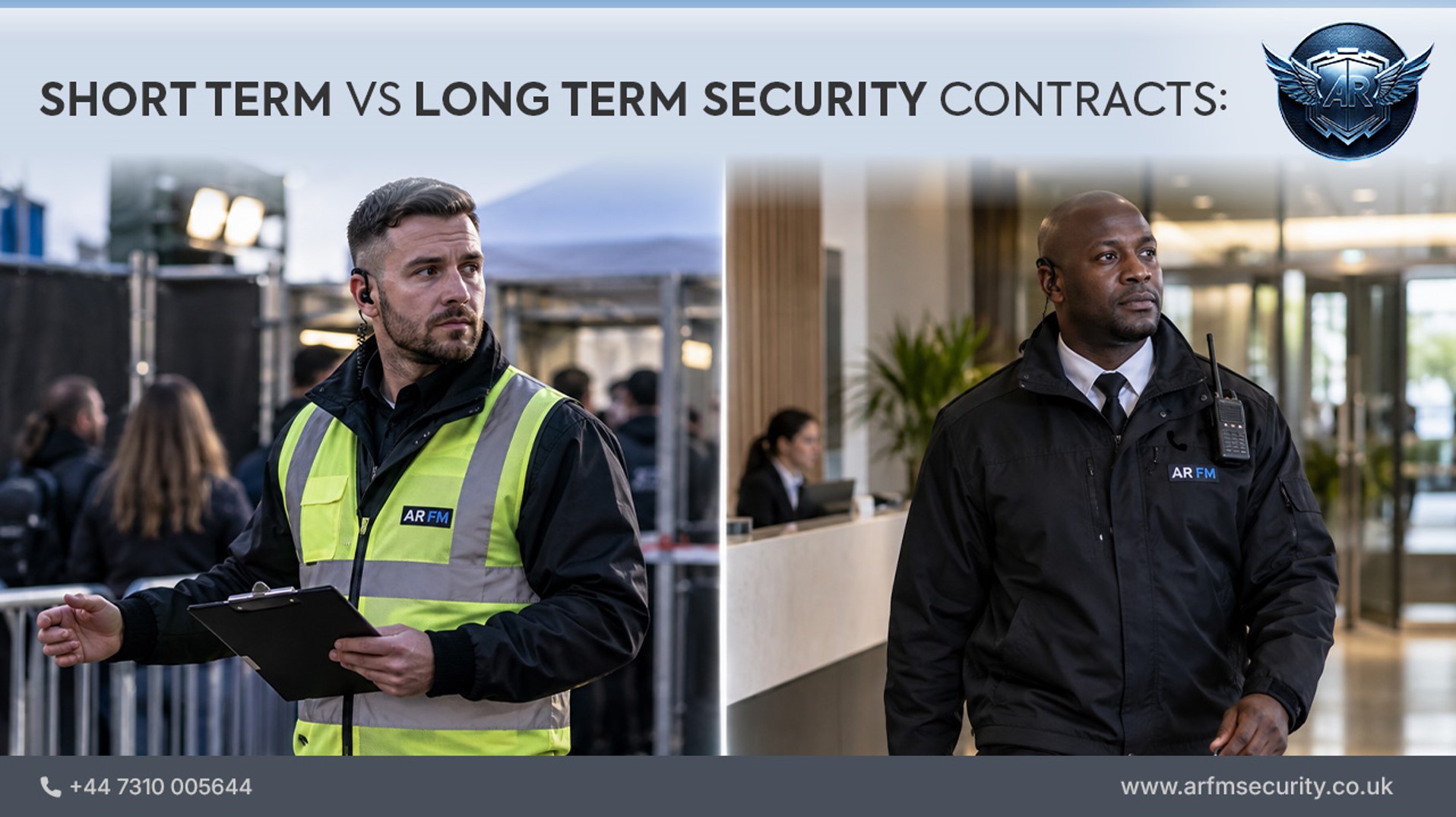
Short Term vs Long Term Security Contracts: Which Is Right for Your Business?
Not every business needs a guard on site 365 days a year, and not every business can rely on booking cover week by week. Choosing between a short term security contract UK providers offer and a longer, fixed-term agreement comes down to your risk profile, your budget, and how predictable your security needs actually are.
This guide breaks down both options, what each costs you in practice, and how to work out which fits your site. At AR FM Security, we deploy under both models regularly, so the comparison below reflects what actually works for clients rather than what's easiest to sell.
What Counts as a Short Term Security Contract?
A short term security contract UK businesses typically use covers anything from a single shift to a few months. Common examples include event and festival cover, seasonal retail peaks, guarding a vacant property between tenants, protecting a construction site during a specific build phase, or emergency cover after a break-in.
The defining feature is flexibility. You book the cover you need, for as long as you need it, without committing beyond that. AR FM handles a significant volume of this work, with trained guards deployable within 24 to 48 hours for exactly these situations.
What Counts as a Long Term Security Contract?
Long term agreements usually run from six months to several years, with an agreed schedule of guarding hours, named personnel, and a fixed rate. These suit sites with ongoing, predictable risk, including permanent retail units, office buildings, warehouses, industrial estates, and venues that operate consistent hours.
The trade-off is commitment in exchange for continuity, and usually a better rate per hour. AR FM's long term clients tend to work with the same core guards month after month, which is where the real value sits — guards who genuinely know your site, your staff, and your routines.
Cost: The Real Difference
Short term cover carries a higher hourly rate. That's not a markup for its own sake; it reflects the cost of scheduling flexibly, covering short-notice shifts, and not having guaranteed hours to plan around. Expect to pay a premium, particularly for same-week or emergency deployment.
Long term contracts bring the hourly rate down because the provider can plan rotas, assign dedicated staff, and forecast properly. If your site needs regular cover, the annual cost of a long term agreement is almost always lower than booking equivalent hours ad hoc.
When AR FM quotes, we're upfront about this difference rather than pricing everything the same and hoping you don't compare. This is one reason clients often start short term with us and convert to a longer agreement once they've seen the service.
Flexibility and Cancellation
Short term contracts provide greater flexibility when security requirements change. If a sale completes, an event passes, or a temporary risk period ends, you can stop booking cover when it is no longer required.
Long term contracts usually carry a notice period, commonly 30 to 90 days. Before signing anything, check the cancellation terms carefully, particularly whether you can scale hours up or down during the contract without penalty.
AR FM builds flexibility into long term agreements where we can, because a contract that doesn't flex with your business needs may not provide the practical flexibility you require.
Guard Consistency and Site Knowledge
A guard who has worked your site for eight months knows which fire door sticks, which delivery driver is legitimate, and which corner of the car park attracts trouble at closing time. That knowledge is genuinely valuable, and it only builds over time.
Short term cover, by nature, means less continuity. Good providers mitigate this with thorough site briefings and digital handover records.
At AR FM, every guard is briefed on site-specific requirements before deployment and logs activity digitally so the next guard can pick up where the previous one left off. However, this is not always a full substitute for having a familiar security professional who knows the site well.
When to Choose Short Term Cover
A short term security contract UK wide may make sense when:
- You're running a one-off event, launch, or promotional period
- A property is temporarily vacant during a sale, refurbishment, or tenant change
- You need emergency cover following a break-in, threat, or incident
- Seasonal trading creates a temporary spike in footfall and risk
- A construction or site works phase needs protecting for a defined period
- You want to trial a provider before committing to a longer agreement
Starting short term can also give businesses an opportunity to understand how a security provider operates before committing to a longer agreement.
When to Choose a Long Term Contract
A long term agreement may be suitable when:
- Your site needs regular, predictable cover week to week
- You want consistent guards who build real familiarity with your premises
- Budget certainty matters and you need a fixed, forecastable cost
- Insurance requirements or landlord conditions specify ongoing security
- Your risk is continuous rather than seasonal, such as high-value stock, sensitive sites, or 24-hour operations
- You want a lower effective hourly rate across the year
For businesses with ongoing security requirements, a longer agreement can also make it easier to plan staffing, rotas, and security expenditure over the year.
The Middle Ground: Rolling and Hybrid Agreements
The choice isn't always binary. Rolling monthly contracts can provide long term-style continuity with short term-style flexibility, while hybrid arrangements allow businesses to maintain a baseline level of cover throughout the year and scale up for known peak periods.
This is how some of AR FM's retail and venue clients operate — a steady core presence supported by additional guards during sales events, bank holidays, or busy weekends, all under one agreement rather than two separate bookings.
How to Decide
Ask yourself three questions.
First, is my security need defined by a specific date or ongoing indefinitely?
Second, how much does guard familiarity with my site actually matter to me?
Third, do I need budget certainty or budget flexibility more?
If your requirements are defined, temporary, and flexible, short term cover may be appropriate. If they are ongoing, predictable, and dependent on site familiarity, a long term contract may be more suitable.
If you're genuinely unsure, a professional security provider should be able to discuss your requirements and explain the available options before you commit to a contract.
Discuss Your Options With AR FM Security
AR FM Security offers both short term and long term security contracts across Birmingham, London, and the wider UK, with SIA-licensed and fully vetted guards, digital incident reporting, rapid deployment within 24 to 48 hours, and transparent pricing on both models so you can compare properly.
Not sure which contract type fits your site?
Get a free quote or call 07310005644 to discuss your requirements and the level of security coverage your business needs.